Private Credit in Transition: finccam at the Private Credit Forum
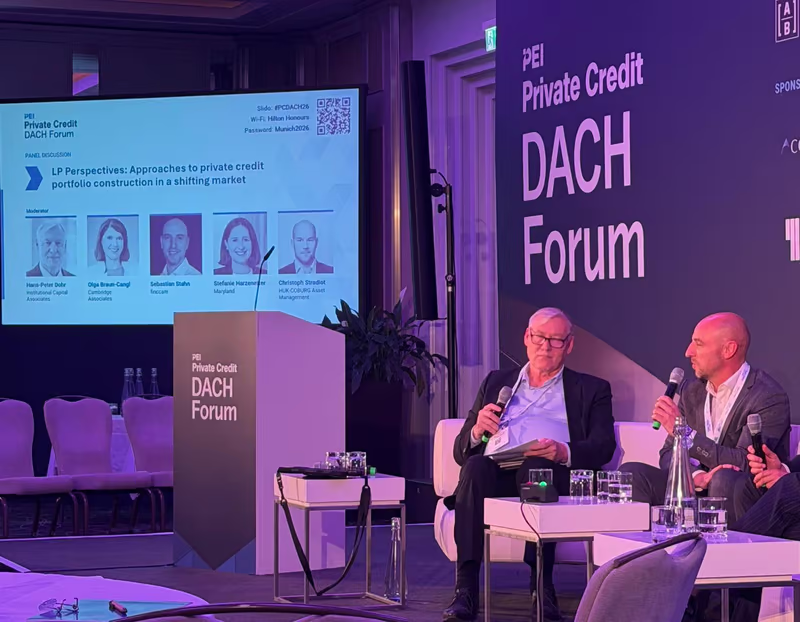
How do institutional investors construct a private credit portfolio in a market that is noticeably shifting? Sebastian Stahn discussed this question on behalf of finccam on the LP panel “LP Perspectives: Approaches to private credit portfolio construction in a shifting market” at the PEI Private Credit DACH Forum in Munich. Alongside Olga Braun-Cangl (Cambridge Associates), Stefanie Harzenetter (Maryland) and Christoph Stradiot (HUK-COBURG Asset Management), with Hans-Peter Dohr (Institutional Capital Associates) moderating, he contributed the investor perspective on senior secured direct lending funds.
The panelists agreed: dispersion of outcomes between managers is increasing, exits are taking longer, and liquidity and governance are moving into focus. In manager selection, what matters is therefore less the track record in good years than the work done in difficult phases: strong workout teams, robust documentation and covenants, transparent reporting and a realistic assessment of distributions. Added to this are geopolitical risks such as tariffs and volatile interest rates, which put sector concentrations, supply chains and capital structures in the portfolio under closer scrutiny.
“For us, senior secured does not automatically mean low risk. We look very closely at how a manager handles difficult situations – that is where, in this market environment, the wheat is separated from the chaff,” said Sebastian Stahn.
On portfolio construction, the panel also discussed liquidity planning, vintage diversification, regulatory requirements and the question of manager concentration. The conclusion: private credit remains attractive, but demands greater discipline in selection, monitoring and portfolio construction.
We thank PEI for the invitation, Hans-Peter Dohr for moderating, and our fellow panelists for the open exchange.