Purism in the Vineyard: Martin Gojer (Pranzegg Winery): “Anything but Compromise”
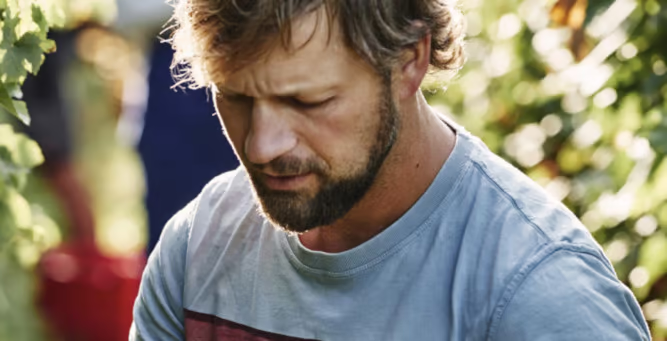
The question of what is essential does not only arise in institutional investment. Martin Gojer from South Tyrol is a winemaker who runs his winery with a very puristic philosophy. Join us below and discover the many things his approach has in common with the world of puristic investing.
What do exceptional wines have that others do not? Sometimes it is exactly what they do not have: aids, flattery, airs and graces, compromises. A visit to the Pranzegg winery in Bolzano teaches you this. Books have been written about how to make good wine. Dozens. No, hundreds. Practical handbooks, philosophical treatises, scientific studies, textbooks. You could fill whole libraries with them. When you talk to the young winemaker Martin Gojer of the Pranzegg winery on the Kohlerer Berg above Bolzano, you cannot shake the feeling that he knows many of these books, that he knows exactly what is in them, that he has studied them. And you cannot shake the feeling that at some point he began to tear out a page here and a page there, and another and another, more and more, until nothing of all that received wisdom was left but an empty cover. And one insight: wine turns out best when the cellar master holds back as much as he possibly can. “Our only job is to accompany the grape to the glass,” says Martin. Although that “only” deserves a few quotation marks of its own.
Selling grapes? Boring!
If Martin Gojer’s philosophy of winemaking were a road, it would lead dead straight from the vine to the glass. No turnings, no bottlenecks, no detours, no bends, no frills. Knowing this, the Pranzegg winery is actually in completely the wrong place. To reach it, you have to take the narrow, winding road to Kohlern, which is hard to see along, and after the first few hairpin bends an even narrower drive to the farm. There we are welcomed by Martin Gojer and his partner Marion Untersulzner, who run the winery together. Martin comes in from the vineyards that surround the farm. His hands speak of hard work, the full beard on his face of a sense of fashion, or perhaps of convenience. Who knows. When he tells his story, he does so with focus and care, so it is no surprise that he starts at the beginning. In 1935, Martin’s grandmother bought the Pranzegg farm. Until the 1970s it was run as a typical mixed farm: with livestock, fields, forest and vines whose grapes were sold. For a long time, making wine on the farm itself was not an option at Pranzegg. That did not change at first when Martin took over the farm in 1997, aged just 18. He went on growing grapes and selling them. “But at some point I found it too boring just to sell grapes,” Martin remembers, “there was no way for me to develop and grow.” So in the first years of the new millennium the young farmer changed a number of things: he replanted vines and renovated the house and the cellar. This laid the groundwork for going into the wine business himself. “In 2009 we put our first vintage into the cellar.”
More becomes less and less
They started out with two hectares of vines. The vineyards are steep, and most of the work has to be done by hand. So they lacked almost everything that industrial production would need: land, machinery, rationalisation. But industrial production is not what Martin has in mind anyway. It would not suit his attitude, his philosophy of life or his nature. Instead, the young winemaker takes the stony path of doing without. His father had already used neither herbicides nor fertiliser, “so I took over good soil,” says Gojer. He soon noticed that he could also do without certain pesticides. “You gain more and more experience, you have more and more courage, and at some point you know: you can manage entirely without synthetic products.” It was a gradual process, he says, and when his daughter Caroline was born in 2009, spraying synthetic pesticides simply did not feel right any more. So Martin first converted his farm to organic farming, and since 2014 he has worked biodynamically. This way of farming suits his approach best. Biodynamic agriculture puts great weight on individuality: every farm is looked at on its own, cycles are kept small, and soil and plant are seen as one. “We don’t just leave things out, we also add a few natural inputs, which are derived not least from the cosmos, from the stars and the moon,” Martin explains. And: “For me it is not a matter of belief, I am a very pragmatic person: I tried it and simply saw that it works.” So Martin follows no belief, no whim, no trend and no marketing idea either. That becomes clear at the latest when you look at the labels on his wine bottles: they do not even mention “organic”. “For us, biodynamic farming is not a selling point,” Martin confirms, “we have only one single customer for whom it matters at all.”
Individual and uncompromising
Since those tentative first steps in 2009, Martin, Marion and the Pranzegg winery have grown. They have also grown in size. Today they farm about four hectares of vineyards in Kampill around Pranzegg, in Signat, and in Unterplatten and Oberplatten on the Ritten. So Pranzegg is still a small, manageable winery, which for Martin is the ideal size. “I can make my wine the way I want, I don’t have to make any compromises and I don’t even have to bow to the market,” says Martin. That is exactly what Martin’s wines are built on: individuality and refusal to compromise. “If I let others tell me how to make my wines, I could just as well have gone on selling grapes.” This refusal to compromise goes so far that Martin also does without a protected designation of origin. No “DOC” adorns his bottles, and the winemaker gives three good reasons for this. The first is the expectations that a designation of origin raises among consumers. The second reason is a personal one: if you rely on a designation of origin, you would have to change the way you make wine if you yourself were ever transplanted somewhere else. “But I am convinced that you must not change your basic attitude. That has to stay!” And we already know the third reason: no compromises. In this case, “no regulations” is perhaps the better term.
Restraint, please!
Martin’s way in the vineyards and in the cellar is, by the way, not only uncompromising but also as simple as it is logical. The straight road from the vine to the glass, in other words. The road starts with grapes of the highest possible quality: “We deliberately do without any aids, so we depend on an optimal raw product.” This raw product goes into the cellar, where the grapes can ferment in peace and the wine can mature. “We only step in if there are problems. Otherwise our only job is to pick the right moment to bottle the wine and so to set it in stone in the bottle,” Martin explains. “All we do is accompany the wine.” The uncompromising cellar master also has a good reason for this restrained approach: “The wine simply develops better without our help.” The young winemaker from Bolzano also deliberately does without analyses and relies instead on his experience.
“Mine,” Martin grins, “is an empirical approach.”
With this “empirical approach”, the Pranzegg winery produces 20,000 to 25,000 bottles of exceptional wine a year. Two thirds are red, one third white. The whites are a Gewürztraminer and two blends that focus on the sites they come from. There is a field blend called “Caroline” from the Kampill site (that is, Pranzegg) and one from the Oberplatten site called “Tonsur”. The grapes for the latter grow at 700 metres above sea level on the Ritten and so have completely different qualities and characteristics, which Martin knows how to respect. In the red range, the Pranzegg winery has a light red, the Lagrein “Laurenc” and a Vernatsch, the “Campill”. A special case is the “fuori serie” line. As the name suggests, it is not a fixed wine but changes from year to year. “Something different goes into the bottle every year,” jokes Pranzegg’s cellar master alias winemaker alias salesman alias head of sales.
Recommendations are the best selling point
If you know Martin Gojer’s philosophy, it is hardly surprising that he goes his own way in selling his wines, too. Here as well he dislikes well-trodden paths just as much as selling on price or “some online rubbish”. Instead, Martin and Marion rely on a network of personal contacts and on word of mouth. “People shouldn’t drink our wine because it says where it comes from on the label, or ‘organic’, but because someone they trust has recommended it to them,” Martin explains. And that is exactly how the sales work: from his time as a consultant at a renowned viticulture consultancy in Friuli, Martin knows well-known names in the European wine world. And they know him. “A recommendation from another winemaker is still the best selling point in the wine trade,” says Martin. The small winery now has a sales network through which only about 10 per cent of production is sold in South Tyrol and another 30 per cent in the rest of Italy. Six out of ten bottles, on the other hand, go abroad: to Germany, Austria and Switzerland, of course, but also to Japan, England and the USA. If you look at its history more closely, Pranzegg has not just taken a different route in sales from the usual one, but exactly the opposite route. Normally, a winery first works its home market and only then reaches abroad. For Martin Gojer and his wines it was exactly the other way round. Today the demand for Pranzegg wines is greater than the supply, which alone speaks for the South Tyrolean “natural wine”. But be careful with that term, because Martin is not happy with it either. He dislikes any label that people try to put on him and his wines. Natural wine, so the simple argument goes, is a misleading term, because nature does not produce wine. “Wine is a human achievement. Not only nature goes into it, but also a good portion of culture,” says Martin.
Of living wines and stillbirths
And because wine culture is also drinking culture, one question remains: what makes a good wine for Martin and Marion? It fits the picture that they start at the origins. You can tell from a wine what happened to the grapes in the vineyard, they say: stressed grapes make a stressed wine. “You can simply taste whether only profit maximisation was on someone’s mind or whether there is a certain ethic behind it. You can taste whether it is a styled product or one that has grown naturally,” the two are convinced. Besides the philosophical answer, there is, as you might expect, an equally pragmatic and simple answer to the question of good or bad wine: “When you take a first big sip and then drink the whole bottle together, the wine has to bring the conversation to life. A good wine does not go to your head. It does not make you drunk and it does not make you tired,” Martin and Marion agree. There are wines where you know after the first sip: they are not good for us. “And then there are wines where a whole world opens up with the first sip,” Martin adds: “That is the difference between living wines and stillbirths.”
Many thanks to Marion and Martin Gojer! Source: esemdemi (www.esemdemi.it); authors: Robert Wieser, Christian Rainer; photographer: Mike Krueger (www.kruegermike.com).